Women’s sexual honour code
The House of Bernarda AlbaWomen’s sexual honour code is the rule that makes unmarried women’s sexual conduct a test of family reputation and a ground for shame and punishment. In the play, it is enforced both by a village ready to pursue an unmarried mother and by Bernarda Alba’s demands that her household control what others hear. The code’s force lies not only in private judgment: communal threats, commands to keep silent, and claims about a dead daughter’s chastity turn reputation into a form of social power.
Definition and Social Reach
The code belongs to a wider culture in which sexual conduct and family honour are closely linked. A woman’s alleged transgression can become public gossip and damage the family name; concern about that public perception shapes Bernarda’s conduct in her household as well as her response to events in the village. The play’s commentary places this concern within a male-dominated social order and distinguishes the villagers’ customary violence from formal law: the account notes that Spain’s 1870 Penal Code permitted a husband to defend his honour with blood in specified circumstances, and that the provision remained until 1963. That history provides context for the persistence of honour-based thinking, not a claim that the play’s events directly reproduce a legal proceeding.
The code is not confined to Bernarda. Her daughters recognize the damage gossip can do to the family name, while Poncia expresses her own wish to live in a respectable household and avoid disgrace. The concern crosses household boundaries: Prudencia’s husband’s dispute with his brothers over an inheritance has become a subject of gossip and a source of damage to his reputation and family distress. In this way, sexual honour belongs to a broader system of public scrutiny, even as women bear its particular sexual restrictions and penalties.
The Village’s Punitive Response
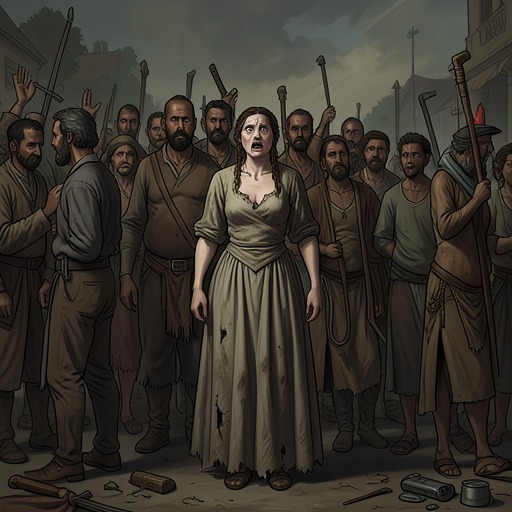
The episode concerning Librada’s unmarried daughter shows the code becoming a collective threat rather than remaining a private judgment. Poncia reports that the woman gave birth to a child whose father is unknown, killed the child to conceal her shame, and hid it beneath stones. Dogs unearthed the body and left it at her doorstep; by the time the news reaches the household, villagers are dragging her through the street as men run from the paths and olive groves to join the pursuit. The sequence makes exposure itself decisive: once her conduct and the child’s death become public, the village turns shame into a demand for punishment.
Bernarda does not call for restraint or for the authorities to intervene. She urges the crowd to come armed with olive switches and pick-handles, and calls for the woman to be killed before the guards arrive. Her words align household authority with the village’s retaliatory judgment, while Adela objects that the woman should be allowed to escape and pleads that she not be killed. Martirio instead insists that she must pay for what she has done. The divided responses expose the code’s competing claims: the woman is treated as answerable to communal honor, while Adela’s protest recognizes her immediate peril. The scene presents the threatened violence as social enforcement, not as a formal sentence under law.
Bernarda’s invocation of the woman’s “sin” and her call for burning coals at its site frame the response in moral as well as punitive terms. She repeats the demand for the woman’s death, and Martirio proposes that the sisters go out too. Adela’s plea and gesture toward her own abdomen make her response personal within the scene, but the evidence does not establish what that gesture signifies. The pursuit thus places the village’s standard before the household as a warning about the consequences assigned to women whose sexual conduct becomes publicly known.
Household Authority and the Policing of Reputation
The same honour code operates inside Bernarda’s house through commands about conduct, appearance, and speech. At the funeral of Antonio María Benavides, Bernarda cuts off the Servant’s grief with an order for silence, criticizes the room’s cleanliness before the mourners arrive, and sends the Servant away, declaring that the poor are like animals and seem made of different substances. Her concern for the household’s public presentation therefore coexists with class contempt: the Servant’s sorrow is subordinated to the demands of decorum and the family’s standing.
Bernarda makes the gender hierarchy explicit when Magdalena curses the condition of women. She declares that what happens in the house is what she commands and contrasts women’s needle and thread with men’s whip and mule, adding that such privilege belongs to people born with means. The rule assigns women domestic work and obedience while allowing men a different sphere of action. Honour is not merely a standard imposed after a scandal; it is part of the household order that restricts women’s choices and makes their conduct answerable to family authority.
As the sisters’ conflict grows, Bernarda describes the house as having five chains for her daughters and invokes the walls her father built so that not even the grass will learn of her distress. The image joins confinement to secrecy: the daughters are controlled, and the house is meant to keep family trouble from becoming public knowledge. Bernarda says she had foreseen a storm but not its sudden breaking, then resolves that she will have to discipline them. Her language presents authority as a response to disorder, while revealing how tightly control, silence, and fear of exposure are bound together.
The household’s concern with what outsiders might hear also appears in Bernarda’s warning that the neighbours will have their ears glued to the walls when her daughters argue. Even a domestic quarrel is treated as a possible threat to reputation. After Prudencia leaves, Bernarda permits the daughters to leave the table; Adela says she will walk as far as the main door for air. The brief permission does not undo the larger structure of surveillance and restriction, in which movement and speech remain subject to household authority.
This structure makes the code more than a rule about sexual conduct. It connects a woman’s reputation to the family’s public image, and turns silence into a means of guarding that image. Bernarda’s repeated orders and her insistence on command show how reputation is enforced in ordinary domestic interactions as well as in moments of public crisis.
Death, Concealment, and the Limits of the Code
At the play’s ending, the demand to protect family honour becomes an attempt to dictate the meaning of death itself. After Adela’s suicide, Bernarda refuses to enter and says Pepe has escaped through the dark trees, though she warns that he will fall another day. She then orders that Adela be cut down and carried to her room, dressed as a virgin, and declares that nobody will speak of what happened. Her repeated assertion that her daughter died a virgin converts chastity from a private fact into a public claim imposed by the surviving head of the household. The command does not undo Adela’s death; it controls how the family is to present it.
Bernarda also orders the bells to ring twice at daybreak and forbids weeping in company, insisting that tears be shed alone. Her final repetition of “Silence!” makes the household’s silence rule the last instrument of authority, now directed at the response to her daughter’s death. The contrast is stark: the village’s honour code had supported calls to punish an unmarried mother, while inside the house Bernarda uses the same concern for sexual reputation to conceal the circumstances of her own daughter’s death. In both cases, female sexuality is made answerable to collective judgment; at the ending, silence and the claim of virginity serve to preserve the family’s public standing rather than disclose the truth.